International experts meet to support raptor conservation
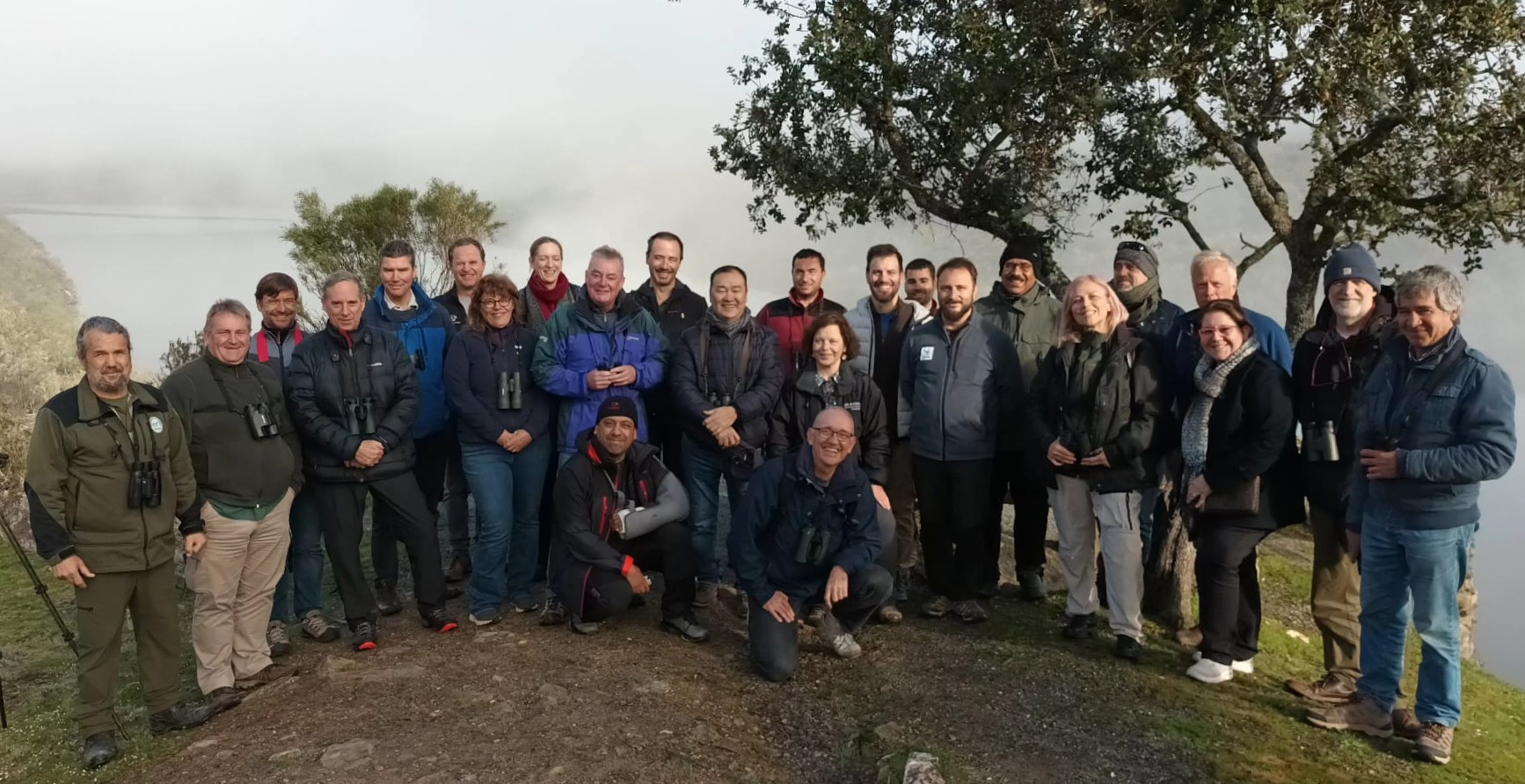
Caceres, Spain, 18-20 February 2025 - Raptor Experts from Asia, Africa and Europe, members of the Technical Advisory Group (TAG) to the Memorandum of Understanding on the conservation of migratory birds of prey in Africa and Eurasia (Raptors MOU) met for the 9th meeting of the TAG in the spectacular Monfragüe National Park. The meeting was generously hosted by the Spanish Government in cooperation with the Junta of Extremadura and the Monfragüe National Park.
The TAG Members, invited experts and observers discussed a dense agenda, with updates on the progress on numerous actions of the TAG Work Plan.
The network of Internationally Important Raptor Sites, which are listed in Table 3 of the MOU’s Action Plan, is composed by over 7,000 sites across the Raptors MOU geographical scope and represent the largest coherent network of sites identified for the conservation of migratory birds of prey in Africa and Eurasia. Their conservation will contribute to the safeguarding of the migratory birds of prey. Sites are identified based on internationally recognized criteria derived from the Important Birds Areas (IBAs) international criteria and include in Europe the Special Protection Areas (SPAs). Experts discussed how to address the overlap between IBAs and SAPs and the need carry out an assessment on how the network effectively covers the species classified as Category 1 species (Globally threatened and Near Threatened) to identify possible gaps in the network.
The meeting also recommended that at the next Convention on Migratory Specie (CMS) Conference of the Parties the CSM Secretariat should propose a Resolution and related Decision on the Internationally Important Raptor Sites to recognise this network as an important tool for raptor conservation and a contribution to CMS goals and to Target 3 of the Kunming-Montreal Global Biodiversity Framework.
Supported by the most recent data of the species movements gathered by several research projects, TAG members agreed that the Bonelli’s Eagle (Aquila fasciata) should be considered as migratory and that a proposal for inclusion of the species in Annex 1 to the Raptors MOU will be table at the next Meeting of Signatories.
A Horizon Scanning for raptors initiative was initiated at the meeting to help experts identify upcoming threats and conservation priorities in the year to come. This will allow TAG to proactively focus research and provide guidance to Signatories.
Other issues covered included an overview of the impact of Climate Change on migratory raptor conservation, a discussion on guidance documents to be produced and on the contents of the second Conservation Status Assessment Report on migratory raptors.
This was only the third time the TAG met in person and the first time since MOS3 when 50% of its membership was renewed, and the meeting strengthened the cooperation among the TAG members. Several invited experts where invited to join the meeting and enriched the discussions during the 2 days of the workshop.
The meeting opened by Mr Borja Heredia, Senior advisor of the Ministry of Ecological Transition and the Demographic Challenge who said: “ The Technical Advisory Group is vital in providing scientific advice on raptors. There are important conservation challenges, including the deployment of renewable energy, with wind and solar farms impacting steppe birds”. He added: “We should recall the legacy of Mr Jesus Garzón who fought for many years to preserve Monfragüe as it is a strong inspiration in the enduring fight for nature conservation”.
Participants were welcomed by Ms Carmen Martín, Director of the Monfragüe National Park that remionded that “The Park not only has an important role to protect the rich biodiversity of birds of prey in Extremadura, but has a long lasting relationship with the Raptors MOU as it hosted in 2017 a preparatory meetings for the development of the Vulture MsAP.”
Mr Umberto Gallo-Orsi who leads the Coordinating Unit of the Raptors MOU said: “Spain’s successes on the conservation of raptors, from the Spanish imperial eagle recovery, the increasing populations of most vultures and of other threatened species is inspiring at global level. The contributions of the members of the TAG are essential in supporting both the Signatories to the Raptors MOU and the Coordinating Unit. The Group provides a valuable platform for collaborative efforts to address specific threats, such as electrocution, poisoning, and climate change, which impact not only birds of prey but also other species of migratory birds. By framing conservation challenges within the broader context of the Convention, this collaboration is expected to foster stronger synergies among key international conservation frameworks”.
![By Francesco Veronesi from Italy (Hooded Vulture - Gambia 17_CD5A2707) [CC BY-SA 2.0 (http://creativecommons.org/licenses/by-sa/2.0)], via Wikimedia Commons](/sites/default/files/styles/teaser_520_520/public/2026-07/Hooded_Vulture_-_Gambia_%2832527881161%29.gif?itok=z4NCMdVa)