Saker Falcon Task Force

Saker Falcon © Andras Kovacs 2010
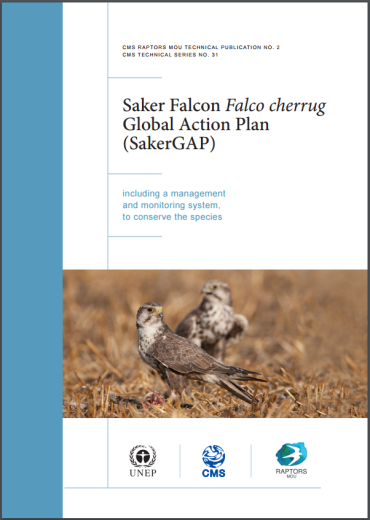
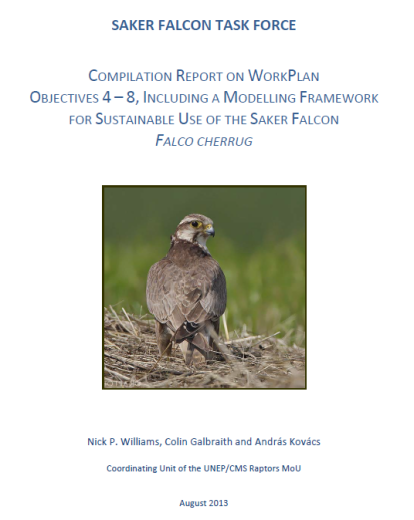
The Saker Falcon (Falco cherrug) is a large and spectacular bird of prey. Due to its prowess as a hunter, it has been prized by humans for centuries, particularly by falconers in the Gulf Region. Over recent decades wild populations of the Saker Falcon have declined dramatically. So much so that at the 10th Conference of Parties (COP10) to the Convention on the Conservation of Migratory Species (CMS), held in November 2011 in Bergen, Norway, the species was uplisted to Appendix I of the Convention (while te Mongolian population was listed in Appendix II), and a dedicated Saker Falcon Task Force (STF) was established under the auspices of the Raptors MOU (see CMS Resolution 10.28).
The mission of the STF was to bring together Range States, Partners and interested parties, to develop a coordinated Global Action Plan, including a management and monitoring system, to conserve the Saker Falcon. The 1st Meeting of the STF was held in March 2012 in Abu Dhabi, United Arab Emirates, at which a detailed Work Plan for 2012-14 was developed. The 2nd Meeting of the STF was held in September 2013 in Abu Dhabi.
The STF comprises over 40 specialists, representing more than 20 countries. During development of the action plan, STF operated by means of four Working Groups considering the following topics: International Policies and Legislation; Knowledge Gaps; Sustainable Use; and, Fieldwork. The Working Groups were focused to prepare background material to inform the 1st Draft of the Saker Falcon Global Action Plan (SakerGAP) in advance of a Stakeholders’ Action Planning Workshop, held in Abu Dhabi in September 2013. The 2nd Draft was launched for public consultation in March 2014; and the Final Draft was endorsed by the CMS Scientific Council at their meeting in July 2014.
The SakerGAP was unanimously adopted at CMS COP11 in November 2014 in Quito, Ecuador. The Coordinating Unit of the Raptors MOU wishes to acknowledge the funding and support received for the STF from the Parties at CMS COP10, the European Union, the Saudi Wildlife Authority, the Environment Agency - Abu Dhabi on behalf of the Government of the United Arab Emirates, and from the CITES Secretariat.
The Task Force offers a unique opportunity to harness the skills and experience of all the key stakeholders to work towards the shared goal of ensuring the long-term conservation of the species’ wild populations, whilst at the same time developing ways to enable sustainable use of Sakers for traditional falconry purposes. CMS Resolution 11.18 (subsequently revised slightly at CMS COP12) recognises that the work of the STF has been a productive partnership employing a transparent consensus-building approach, involving a wide range of parties; and extends the Task Force remit to oversee SakerGAP implementation.
CMS Resolution 11.18 (Rev.COP15)
Acknowledges that a Decision-Making Structure is under refinement by the Saker Task Force which is a step towards possible future implementation where legally possible of the Adaptive Management and Monitoring Framework, as a voluntary process, to ensure that the use of the Saker Falcon is sustainable, and
Stresses however that the aforementioned existing significant data and information gaps need to be closed before embarking on any future implementation of the Adaptive Management and Monitoring Framework
Instructes the STF to:
a) Actively promote the implementation of the SakerGAP including by continuing to facilitate engagement, communication, cooperation and collaboration between the stakeholders; and coordinate its review;
b) Further develop, refine, and implement, where legally possible, and following best practice, an adaptive management and monitoring framework to improve the present conservation status of the Saker Falcon through, inter alia, regulated, and sustainable use;
c) Promote monitoring and research across the range of Saker Falcon, inter alia to fill information gaps on population size and trend, improve knowledge of the genetic structure of Saker Falcon populations, fill knowledge gaps regarding other key parameters needed for population modelling and contribute new information to any future IUCN global Red List reassessment for the species;
d) Work collaboratively with the CMS Energy Task Force (ETF) to ensure synergies and identify priority areas within the range of the Saker Falcon and promote mitigation measures that could reduce the impact of electrocution from power lines and related energy infrastructure on populations of the Saker Falcon;
e) In collaboration with the CMS ETF and other expert groups, continue to raise awareness of the serious issue of electrocution of Saker Falcon with energy companies and national governments; and
f) Ensure synergies with any relevant work proposed under the CMS Central Asian Flyway Initiative to minimise impacts of energy infrastructure on birds.
Decision 15.173 - Directed to Parties
Party Range States are requested and Non-Party Range States are encouraged to:
a) contribute to the review of the Saker Falcon Global Action Plan (SakerGAP) during the coming triennium;
b) develop and implement monitoring programmes, in order to close the existing data and information gaps.
Decision 15.174 - Directed to the Secretariat
The Secretariat shall:
a) convey Resolution 11.18 (Rev.COP15) to the secretariats of other multilateral environmental agreements, in particular CITES, seeking their support and contributions to the implementation of the SakerGAP;
b) subject to the availability of resources, organize regional workshops of the Saker Falcon Task Force in the coming triennium in countries within the breeding range, to promote the implementation of the SakerGAP and assist them to develop and implement monitoring programmes;
c) subject to the availability of resources, review and update the SakerGAP;
d) invite Range States to renew their Saker Falcon Task Force Membership.
Useful Resources:
- CMS Energy Task Force
- Wildlife and Power Lines: Guidelines for Preventing and Mitigating Wildlife Mortality Associated with Electricity Distribution Networks (guidelines by IUCN)
- Preventing the Electrocution of Birds on Power Infrastructure (guidance by IAF)
- Mongolian Initiative on Raptor Persecution: video (initiative by The Mohamed Bin Zayed Raptor Conservation Fund)
Events:
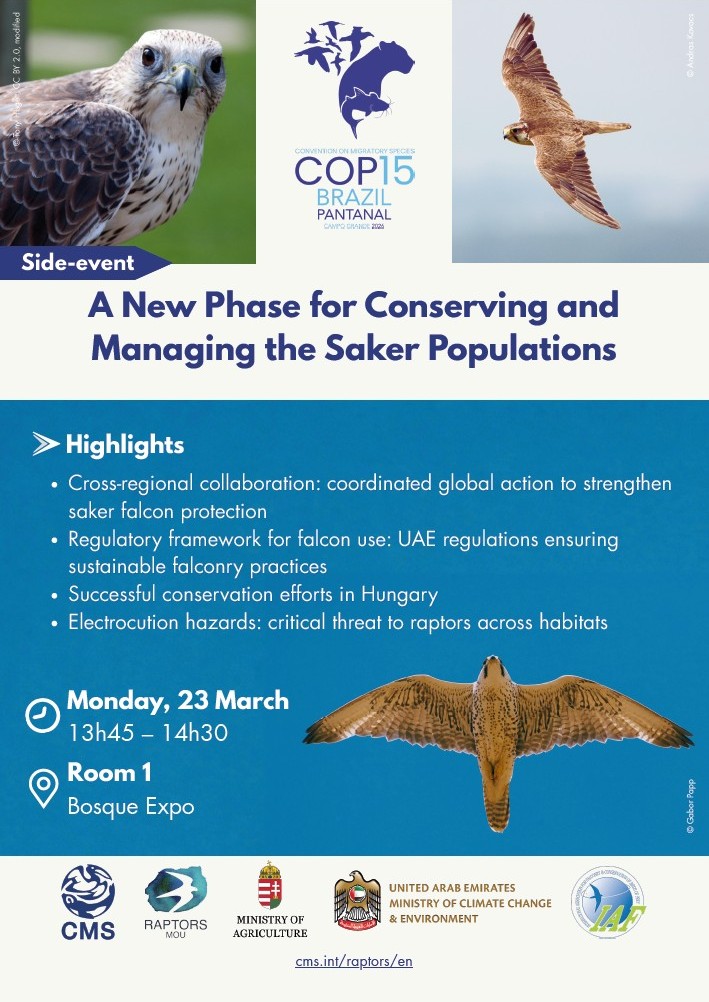
A New Phase for Conserving and Managing the Saker Populations
The side event took place during CMS COP15 in Campo Grande, Brazil, on 23 March 2026. The side event drew strong participation and featured a presentation by Colin Galbraith, Chair of the Saker Falcon Task Force. The programme also included an overview of the United Arab Emirates’ Falcons and Falconers Registration System, a review of successful conservation efforts for the species in Hungary, and the official launch of the report “Changes in Falconers’ Practices and the Impact of Electrocution” by the International Association for Falconry and the Raptors MOU.
Associated documents and presentations are available below:
Event invitation
Banner presentation
Recording of the presentation of Prof. Colin Galbraith, Chair, CMS Saker Falcon Task Force
Recording of the presentation of Ms Shamma Mussabeh AlKaabi, Ministry of Climate Change and the Environment, UAE
Supporting material to Ms Al Kaabi presentation:
Regulating Falconry in the UAE - Registration, Permits & Conservation
UAE Falconry - Regulation, Conservation & Wildlife Protection
Implementing the SakerGAP - A conservation success in Hungary
Recording of the presentation of Mr. Janusz Sielicki, International Association for Falconry and Conservations of Birds of Prey